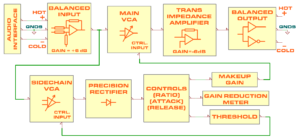
Block diagram of one channel of the MIX BUS COMPRESSOR MASTER board
The KTR-4000 Stereo Mix Buss Compressor is a precision-engineered dynamics processor designed to bring cohesion, energy, and professional polish to your mixes. Built around high-performance VCA gain control elements, the KTR-4000 delivers the unmistakable punch and glue that define countless classic records—now refined with modern precision and flexibility.
The KTR-4000 is composed of several discrete PCB modules that work together seamlessly:
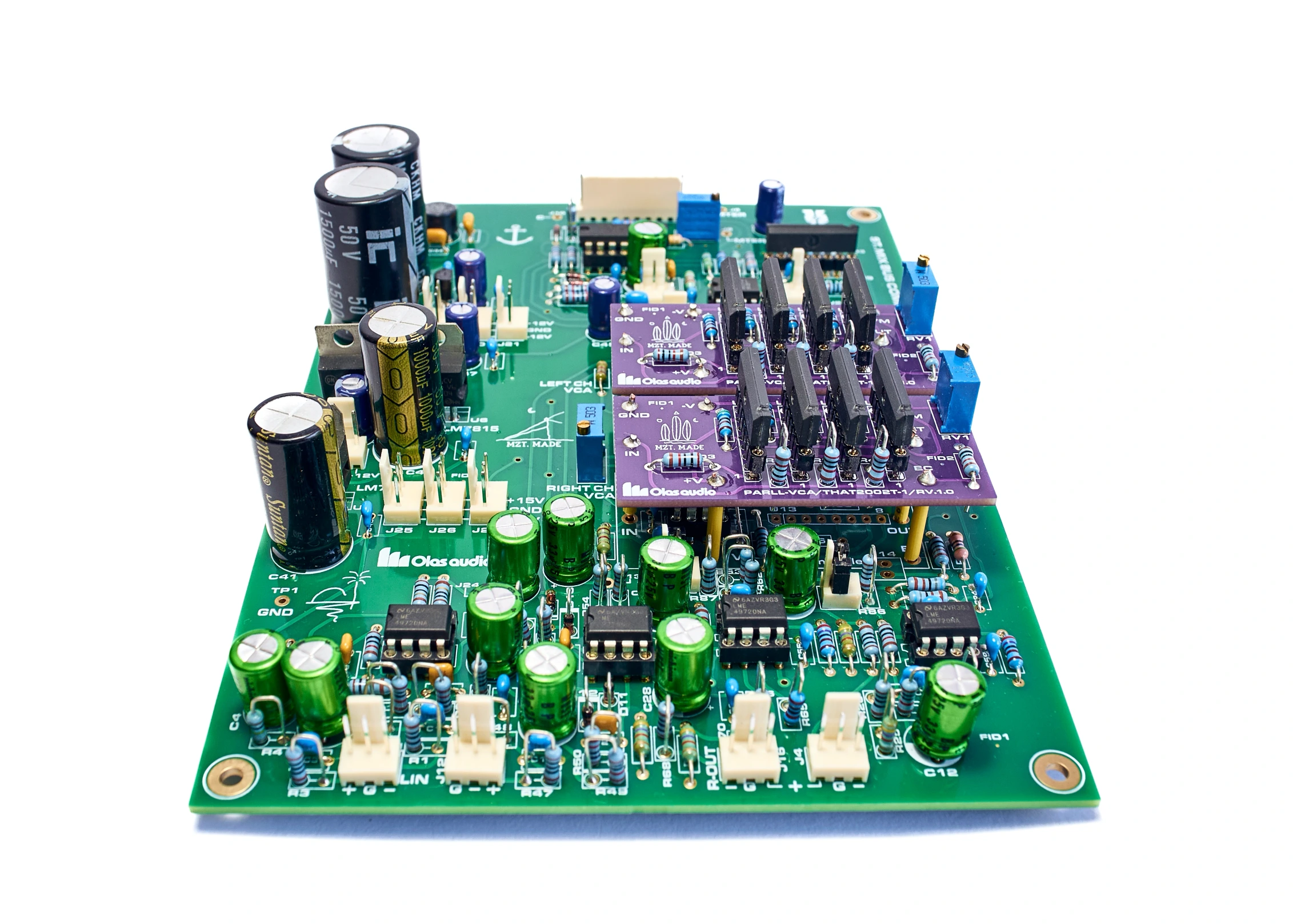
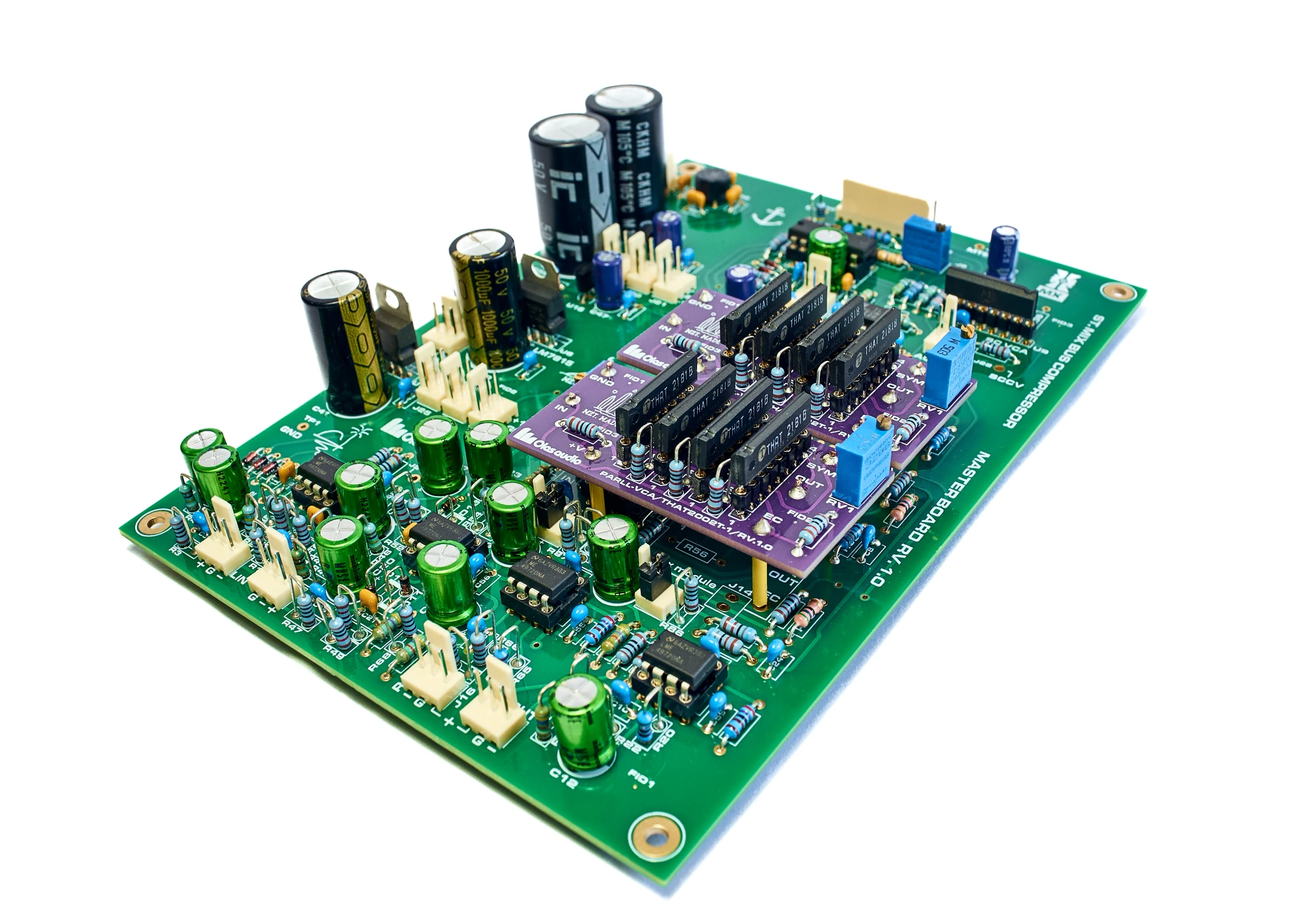
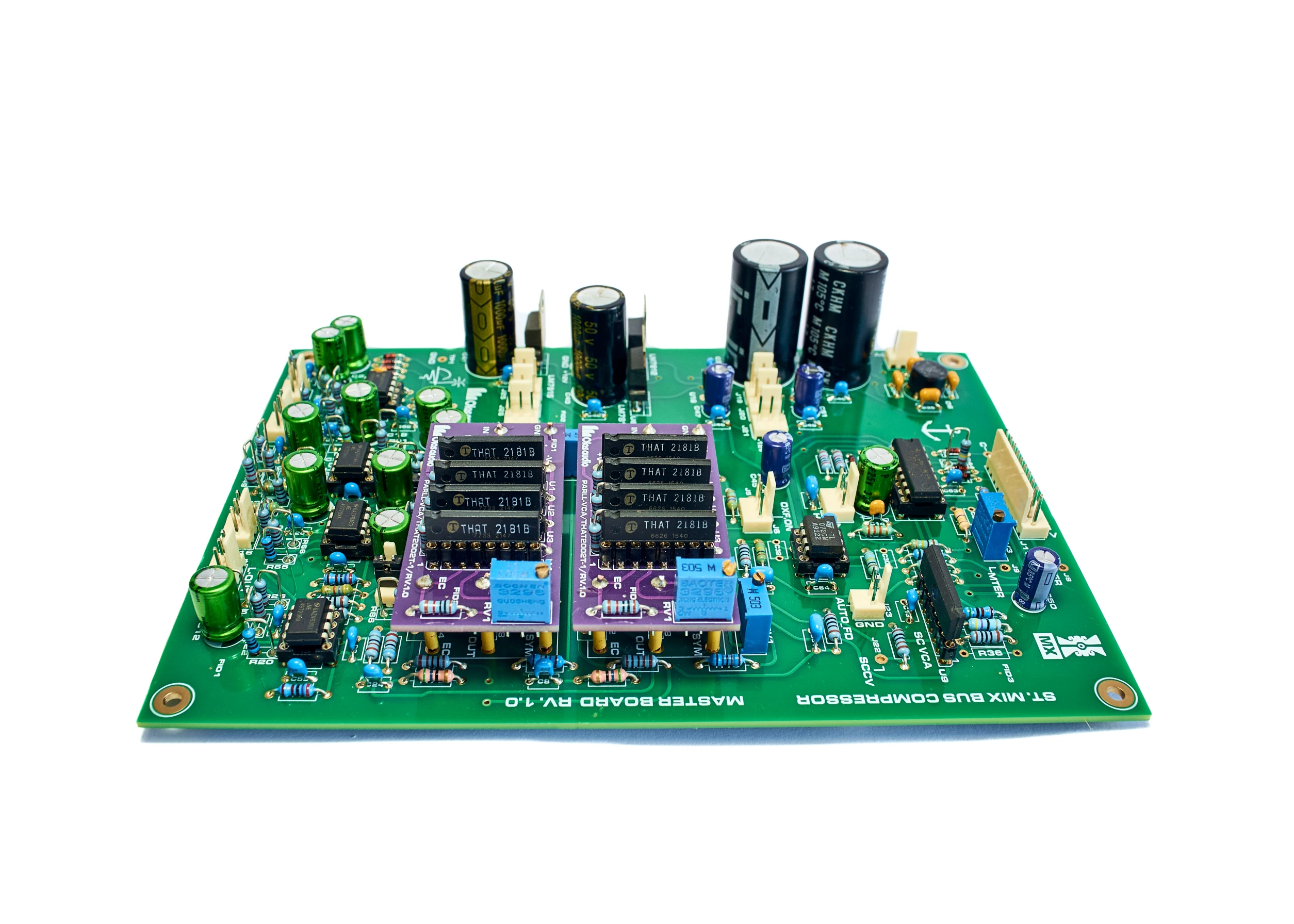
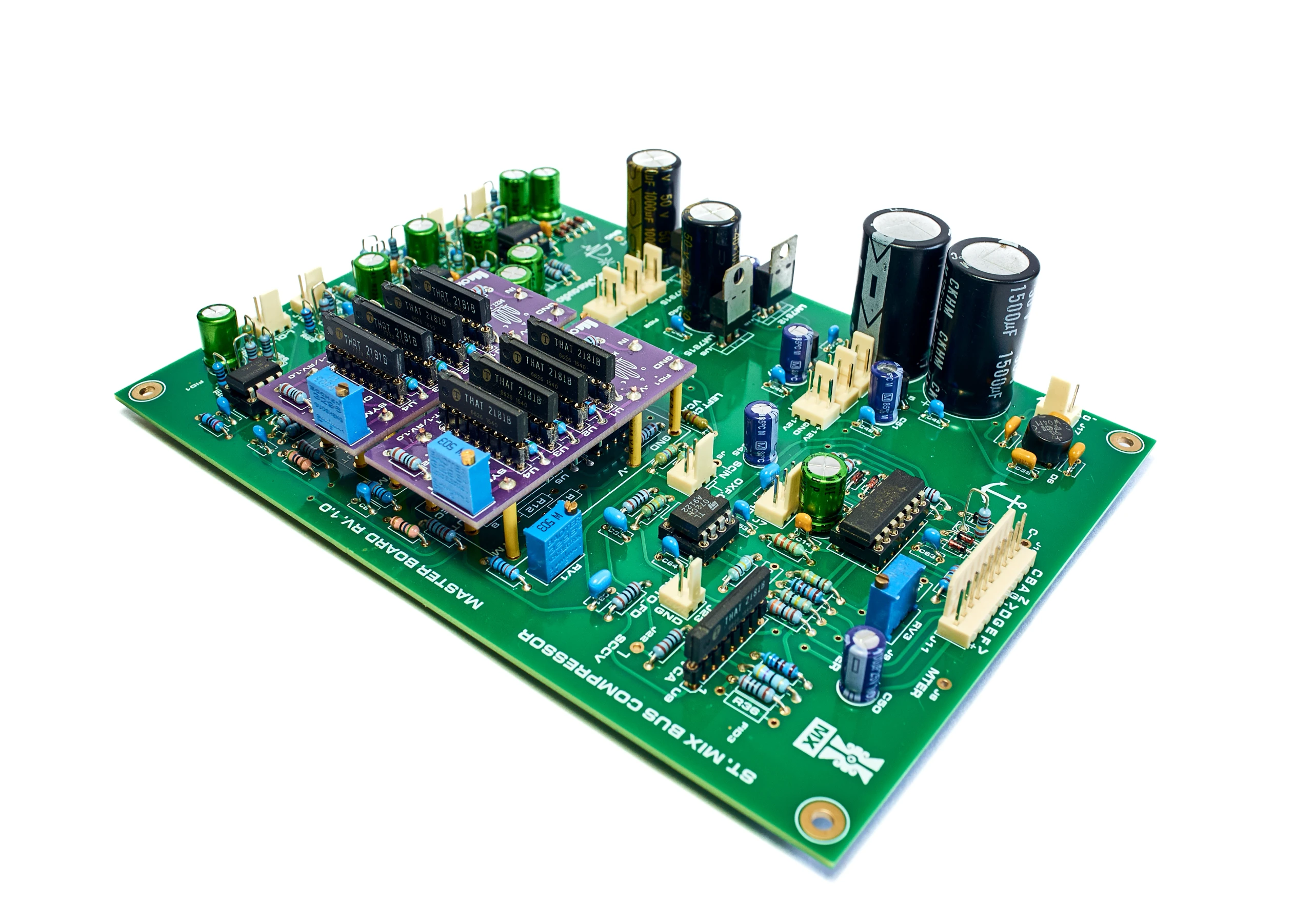
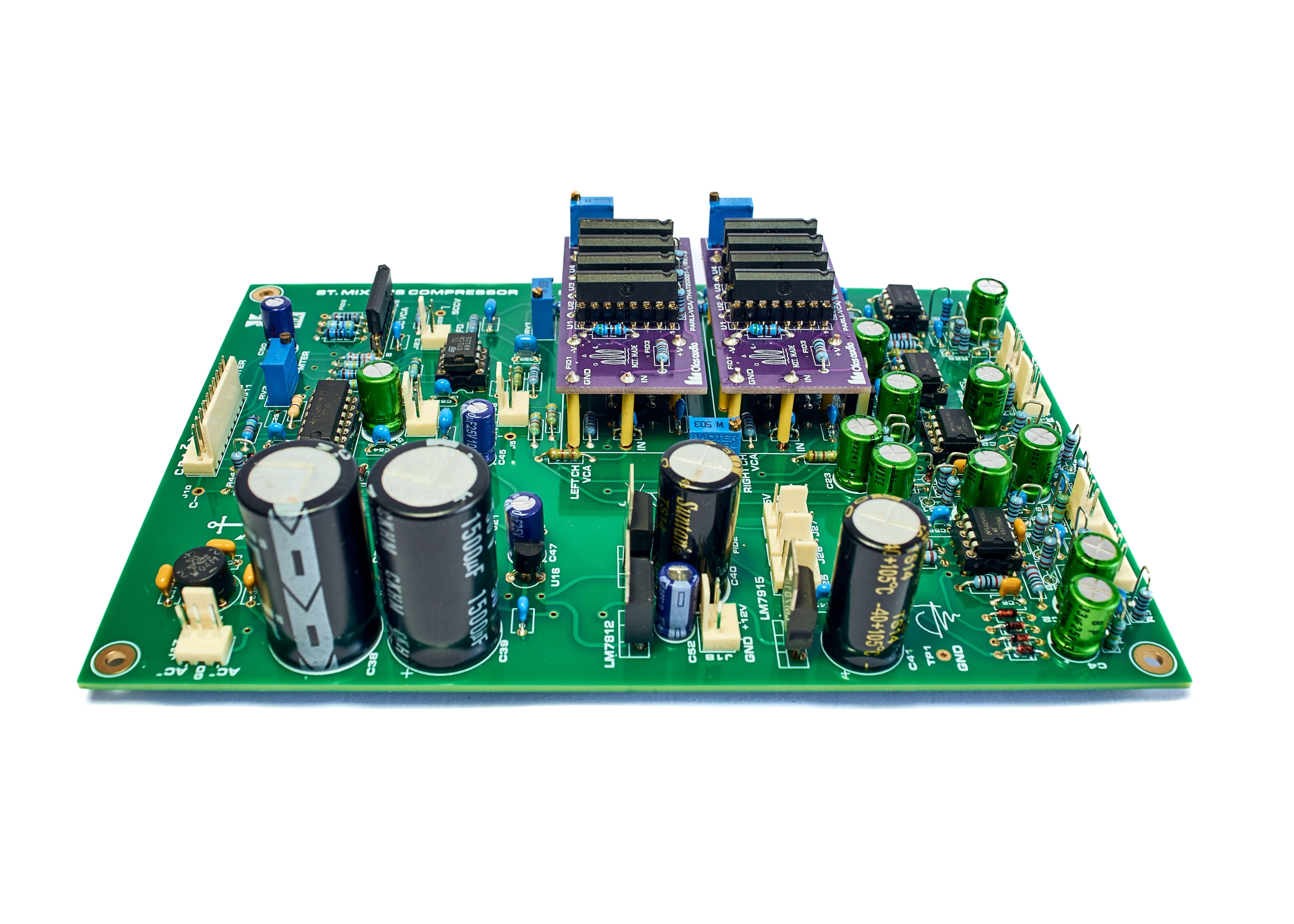
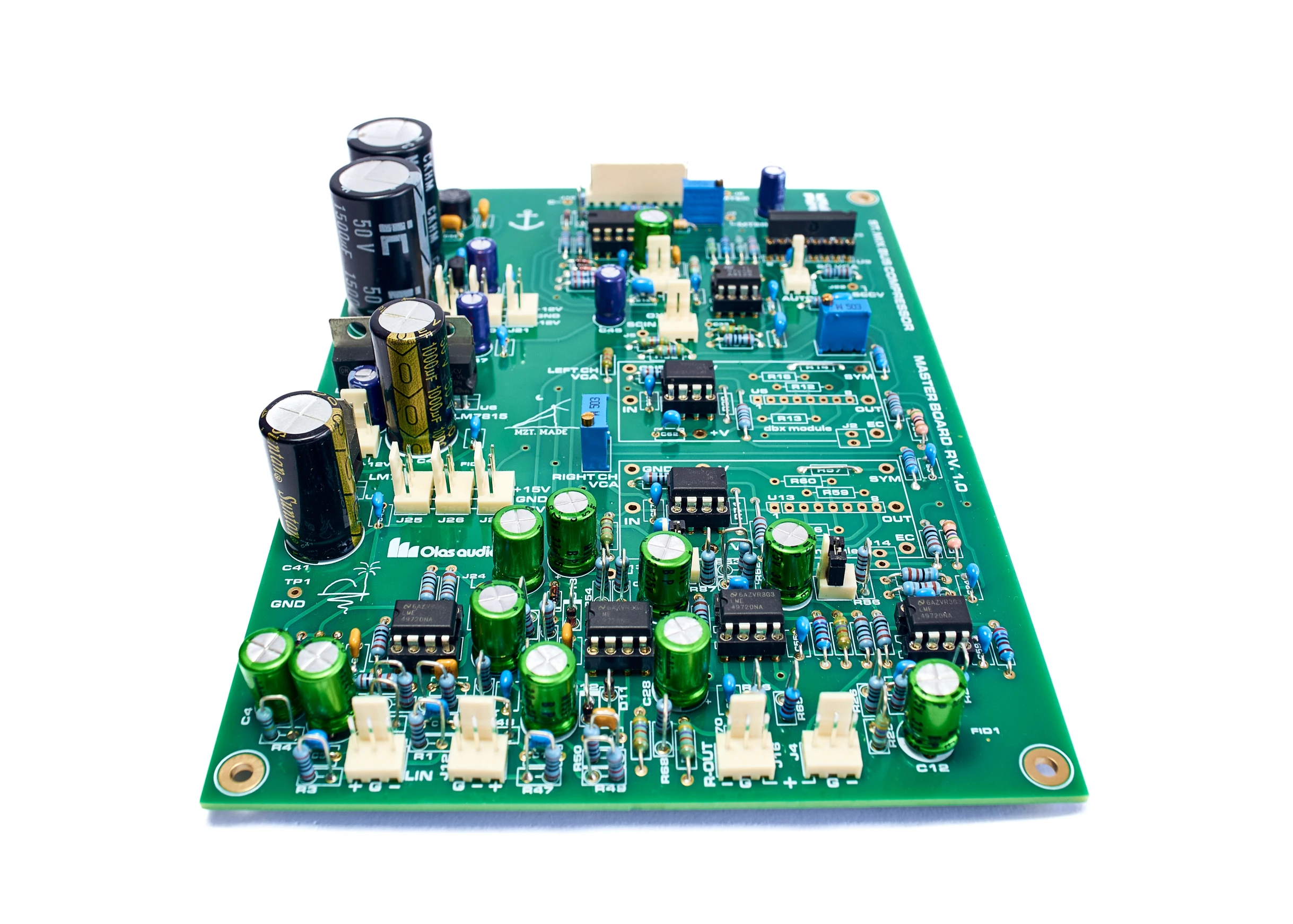
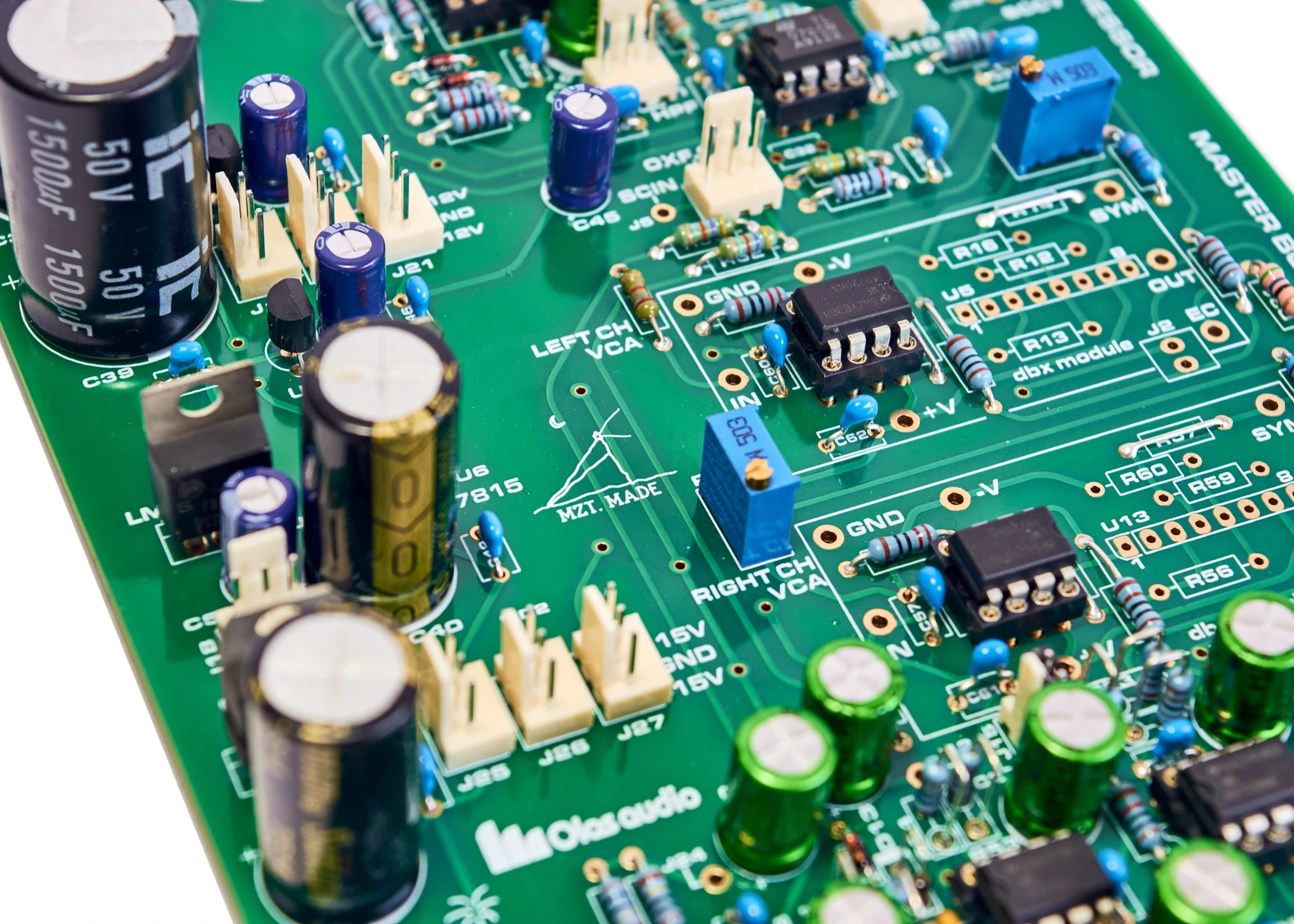
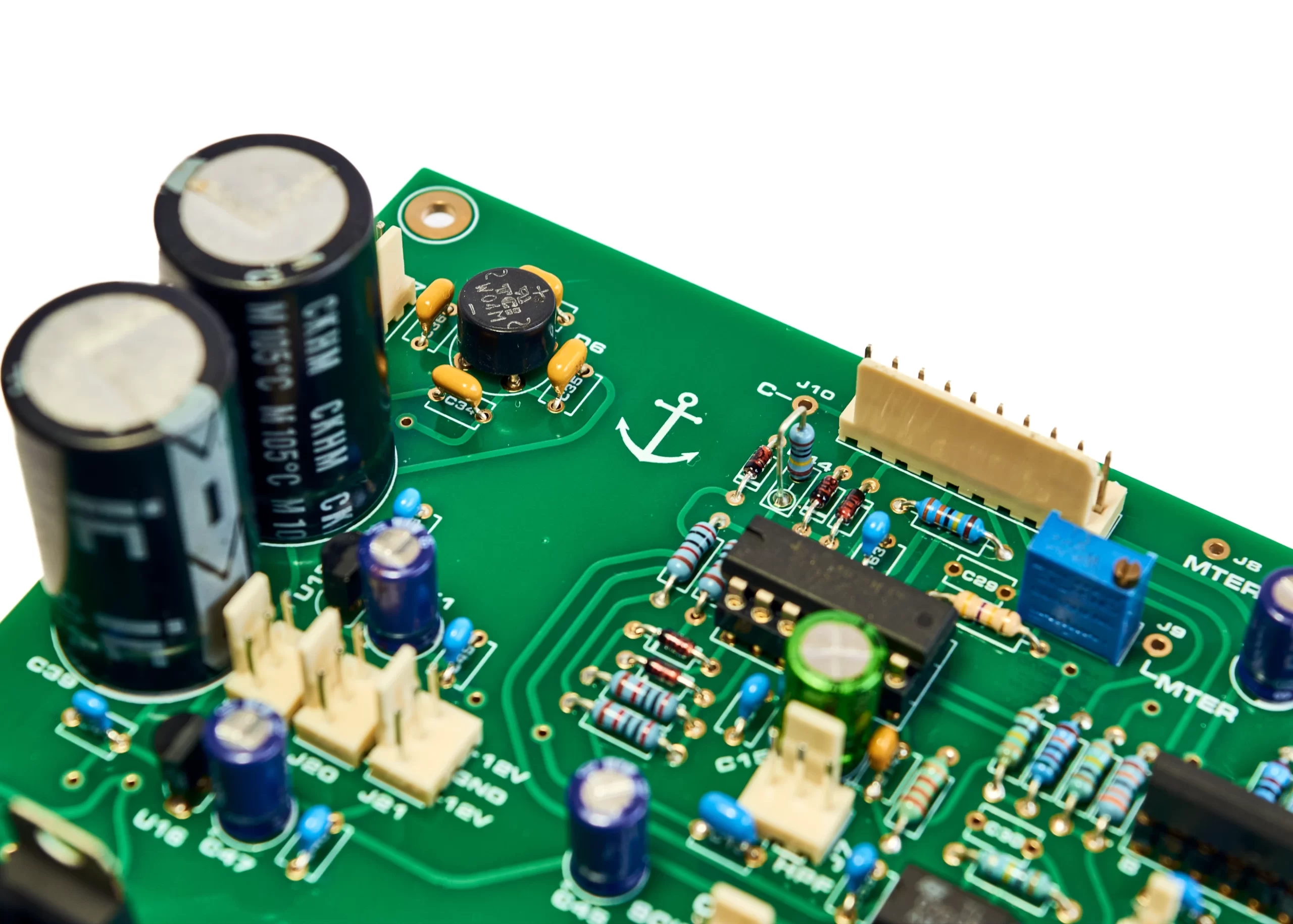
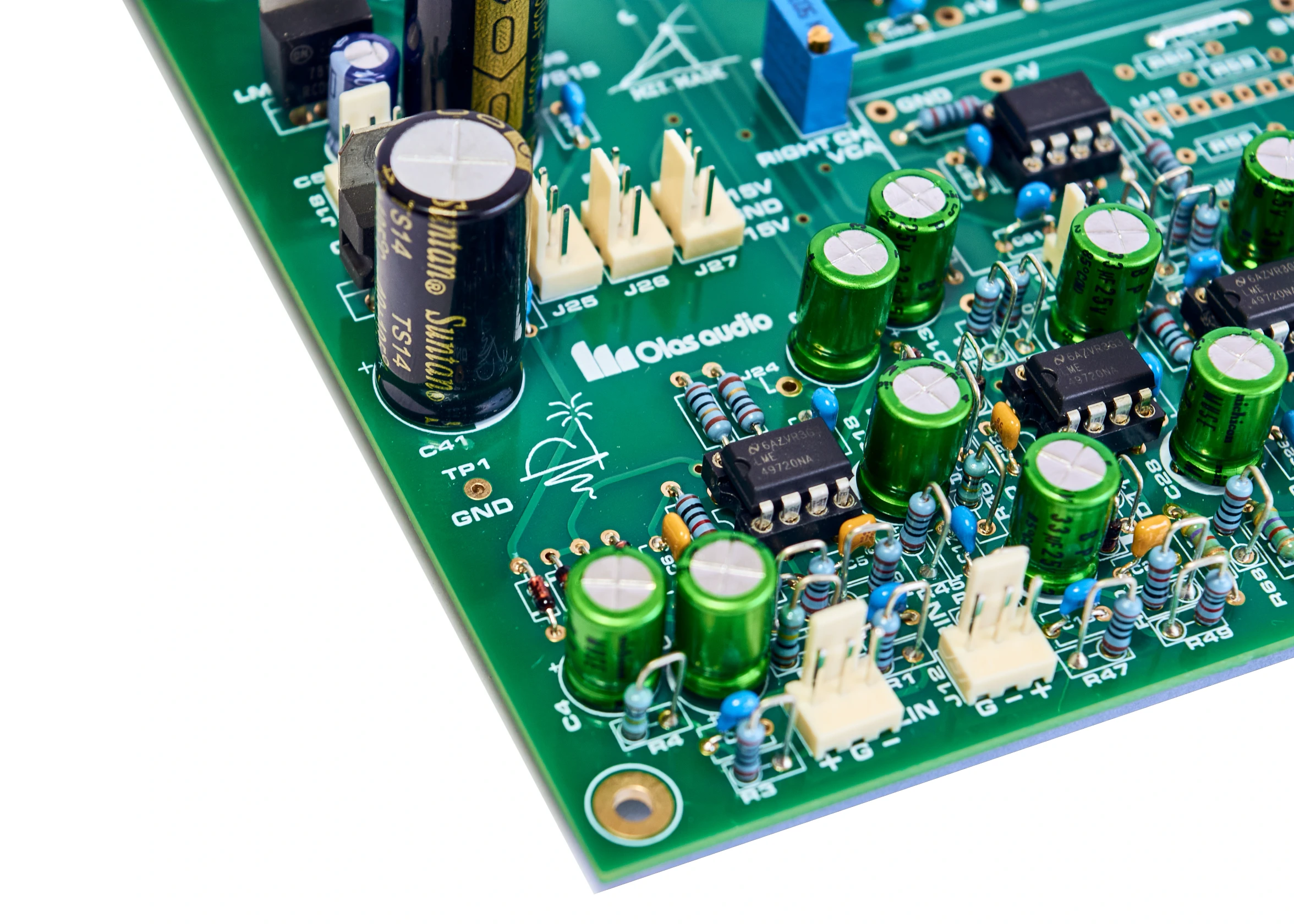
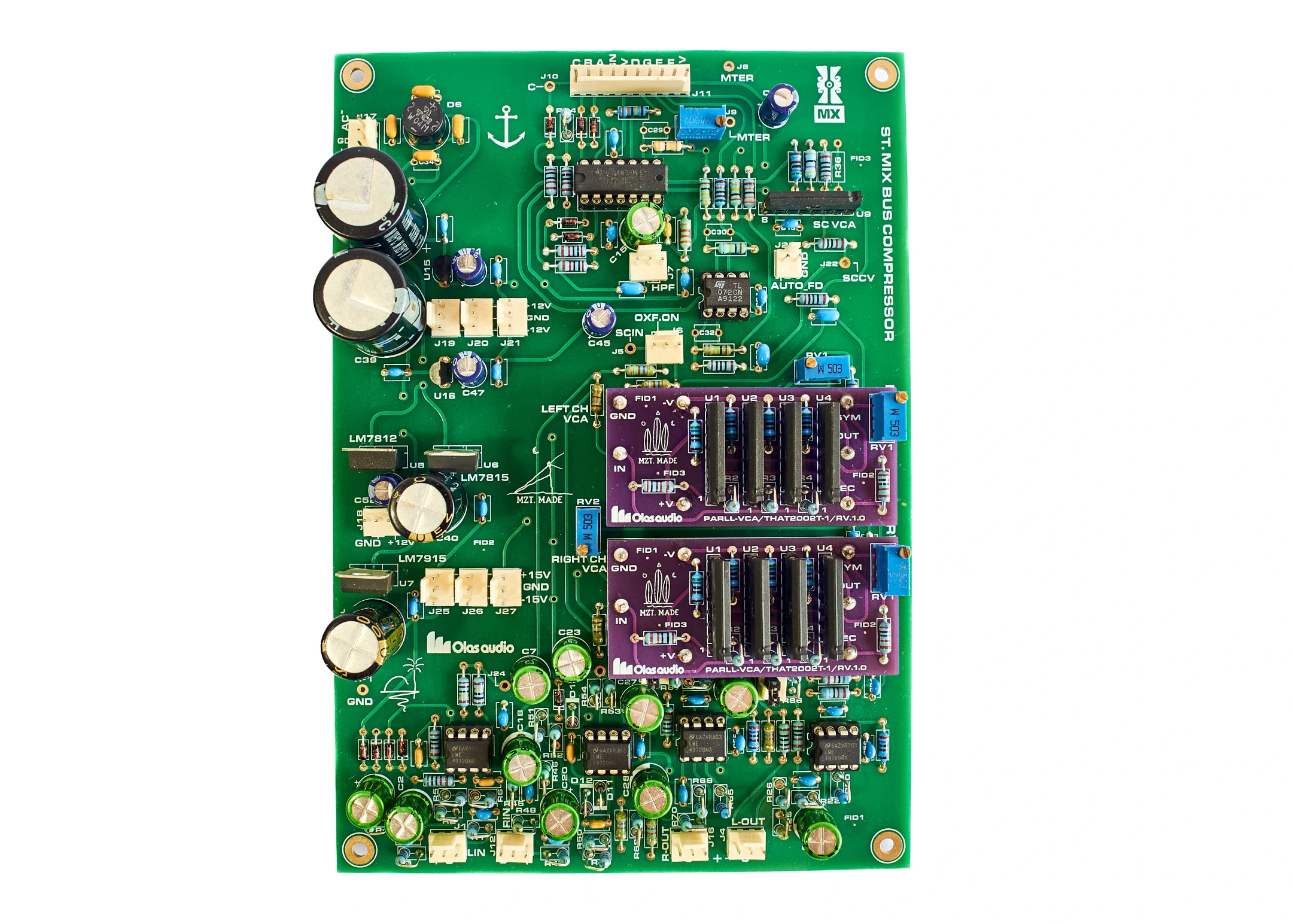
Master Board (Left & Right Channels described in this page) – This is the heart of the compressor, featuring a dual-channel VCA topology for perfectly matched stereo compression and ultra-low distortion performance.
Control Panel Board – Hosts all rotary switches and precision potentiometers for Attack, Threshold, Ratio, Release, and other key parameters, offering smooth, repeatable adjustments and tactile control.
Turbo Board – Provides true stereo sidechain operation, ensuring accurate image stability and consistent compression across both channels, even under the most dynamic mix conditions.
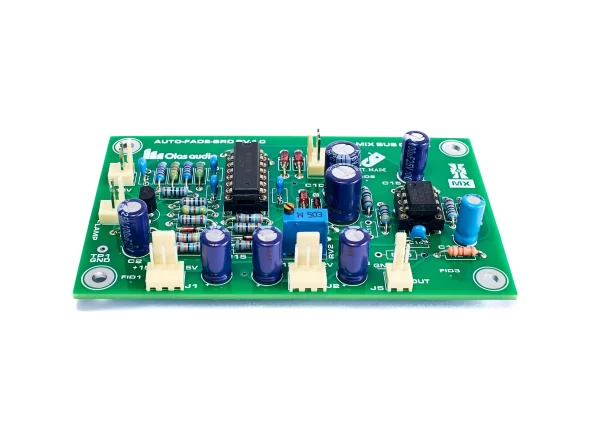
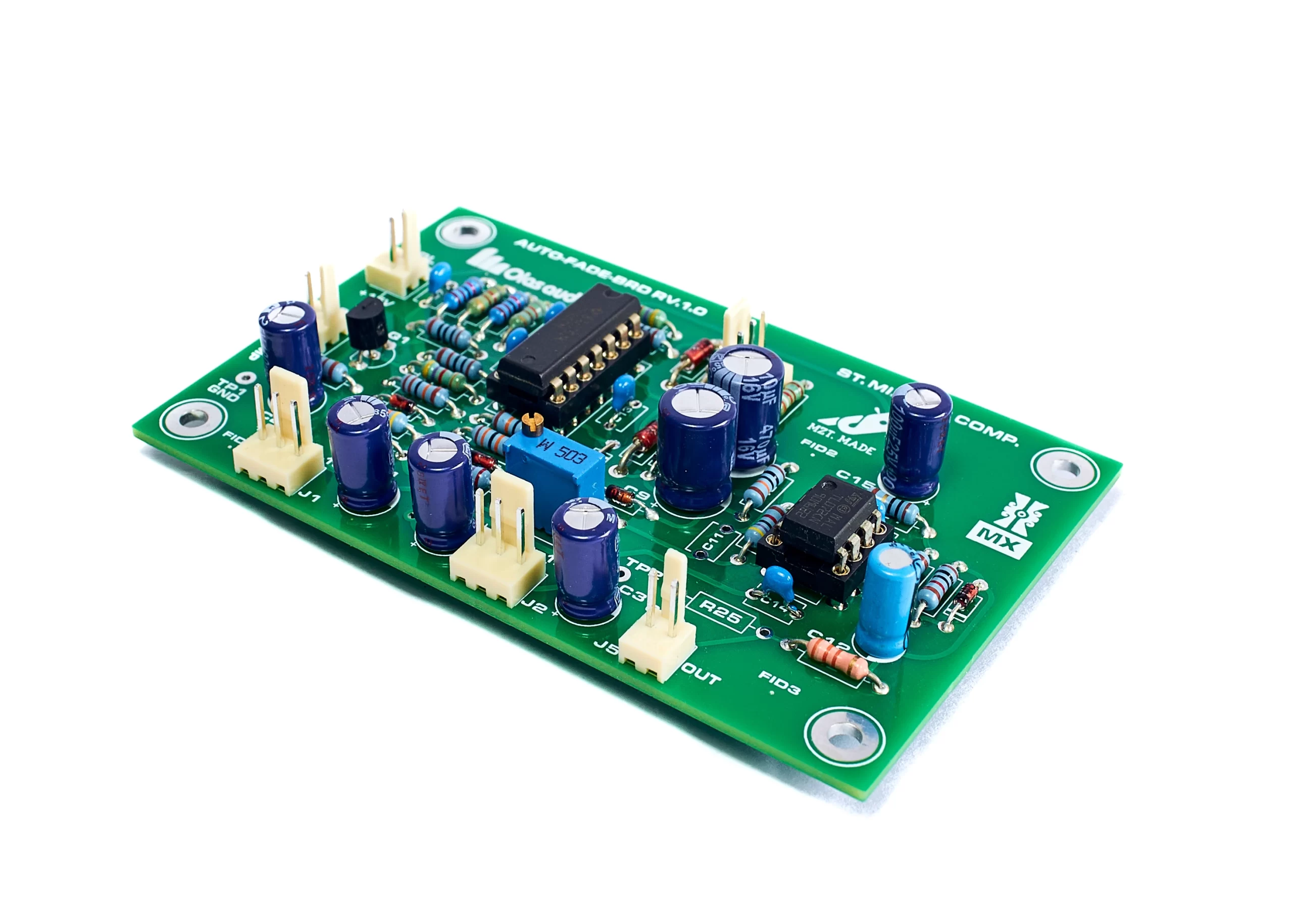
Autofade Board – Enables smooth, programmable fade-in and fade-out transitions directly from the compressor—ideal for mastering workflows and automated session control.
Whether used on the mix bus, subgroups, or in mastering chains, the KTR-4000 enhances depth and cohesion without sacrificing clarity. It delivers solid low-end control, a tighter stereo field, and that unmistakable analog glue that transforms a good mix into a finished record.
What does a Mix Bus Compressor do?
A Mix Bus Compressor controls the dynamic range of a mix by reducing loud peaks and boosting quieter parts, creating a more consistent and cohesive sound. It adds “glue” to blend tracks together and enhances the punch and energy of the mix, especially in genres like rock and pop. By taming peaks, it prevents clipping and allows for more headroom. It is also used during mastering to refine the mix and ensure it sounds good across different playback systems.
As shown in its block diagram, each channel initiates with a balanced input, proceeding to simultaneous processing through both a sidechain VCA and the main VCA. The sidechain VCA’s role is to modulate the dynamic range of the input signal. Following this, there’s a precision rectifier and associated circuitry to determine compression ratio, attack, and release times.
Further stages include a gain reduction meter, a make-up gain control (for compensating the original signal post gain reduction), and a threshold control. The output from the threshold control feeds back to the control terminal of the sidechain VCA, while the output from the makeup gain control returns to the main VCA’s control terminal. After the main VCA, a transimpedance amplifier converts the current signal from the main VCA into a voltage signal. Finally, the balanced output completes the signal path.
It’s essential to emphasize that in this specific scenario, the inherent behavior of the differential amplifier in the balanced input results in an added gain of +6dB. Therefore, it becomes imperative to offset this gain when converting the current output from the main VCA. This adjustment ensures that the entire system maintains a consistent overall gain level.
The following are the main features of the KTR-4000 Stereo Mix Bus Compressor MASTER BOARD:
- Stereo balanced inputs
- Most of the design is based exclusively on the use of a dual bipolar Op-amps, such as the NE5532, LM4562, or LME49720.
- Built in power supply unit (±15V and ±12V)
- Bandwidth: 222 kHz.
- Frequency response: -0.05 dBV at 20 Hz and -0.08 dBV at 20 kHz.
- Common-Mode Rejection Ratio: Better than 77 dB @ 120 Hz.
- Ripple noise: better than -95 dBV for all regulators
- Noise floor: -127 dBu
- Input impedance: > 17 kΩ
- Output headroom: > +22 dBu
- Crosstalk: < -95 dBV @ 1kHz
- Input current consumption (all boards connected): 0.1 AC Max.
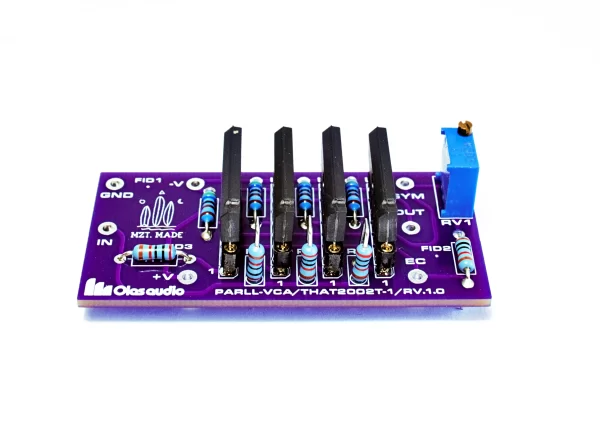
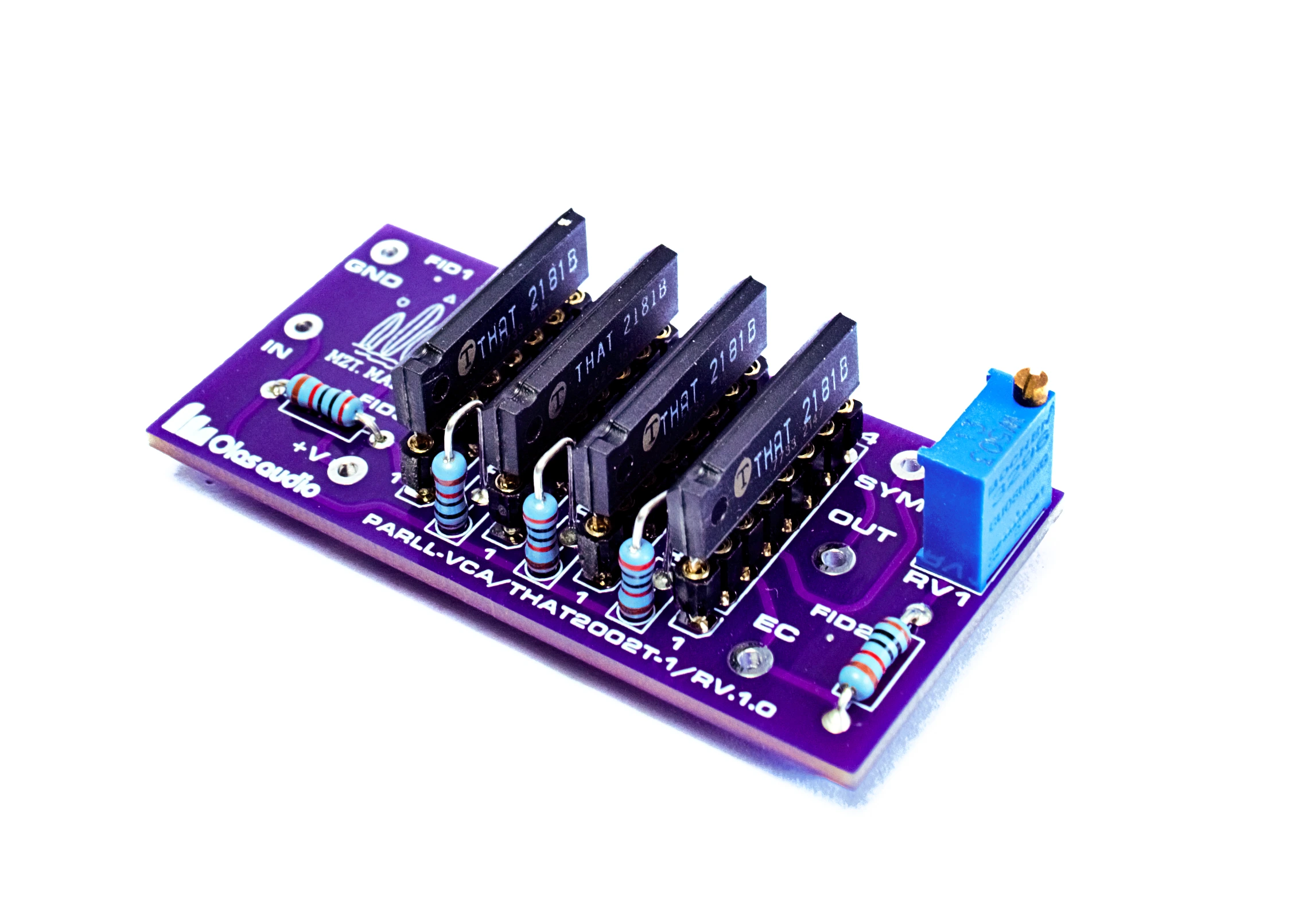
- THAT2002T-1 VCA connection capabilities.
- High-quality double-sided plated-through-hole PCB (ENIG Gold Fingers: 1U”) with solder mask on both sides and full screen print.
- PCB size: length=177mm, width=124 mm. It incorporates four M3 fixing holes.
THD measurement using one VCA (THAT2181) in the main path.
| Vin/Gain | LOAD | THD | |
| @1kHz | @10kHz | ||
| Vin=0dBV
Gain=0dB |
OPEN | 0.0026% | 0.0028% |
| 600Ω | 0.0028% | 0.003% | |
| Vin=0dBV
Gain=-15dB |
OPEN | 0.04% | 0.021% |
| 600Ω | 0.04% | 0.021% | |
| Vin=-5dBV
Gain=+15dB |
OPEN | 0.047% | 0.041% |
| 600Ω | 0.048% | 0.042% | |
| @1kHz:
Vin=+3.16dBV @10kHz: Vin=+1.72dBV Gain=0dB |
OPEN | 0.0054% | 0.0037% |
| 600Ω | 0.0055% | 0.004% | |
THD measurement using the PARLL-VCA in the main path.
| Vin/Gain | LOAD | THD | |
| @1kHz | @10kHz | ||
| Vin=0dBV
Gain=0dB |
OPEN | 0.00047% | 0.0012% |
| 600Ω | 0.0005% | 0.0013% | |
| Vin=0dBV
Gain=-15dB |
OPEN | 0.034% | 0.0054% |
| 600Ω | 0.035% | 0.0055% | |
| Vin=-5dBV
Gain=+15dB |
OPEN | 0.003% | 0.0036% |
| 600Ω | 0.0034% | 0.0042% | |
| @1kHz:
Vin=+3.16dBV @10kHz: Vin=+1.72dBV Gain=0dB |
OPEN | 0.00071% | 0.0016% |
| 600Ω | 0.00073% | 0.0016% | |
The following diagram illustrates the interconnection among various boards designed by Olas Audio, forming the Mix Bus Compressor.
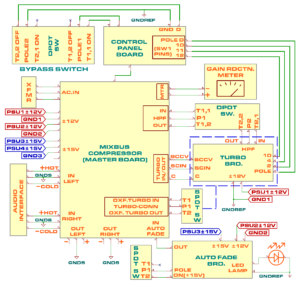
Building Olas Audio’s professional Mix Bus Compressor requires interconnecting multiple boards, including components like the Gain Reduction Meter and switches on the CTRL-PANL, AUTO-FADE, and TURBO-MODE boards.
.
The published price is for the PCB only. A bill of materials and assembly instructions will be provided upon purchase.